
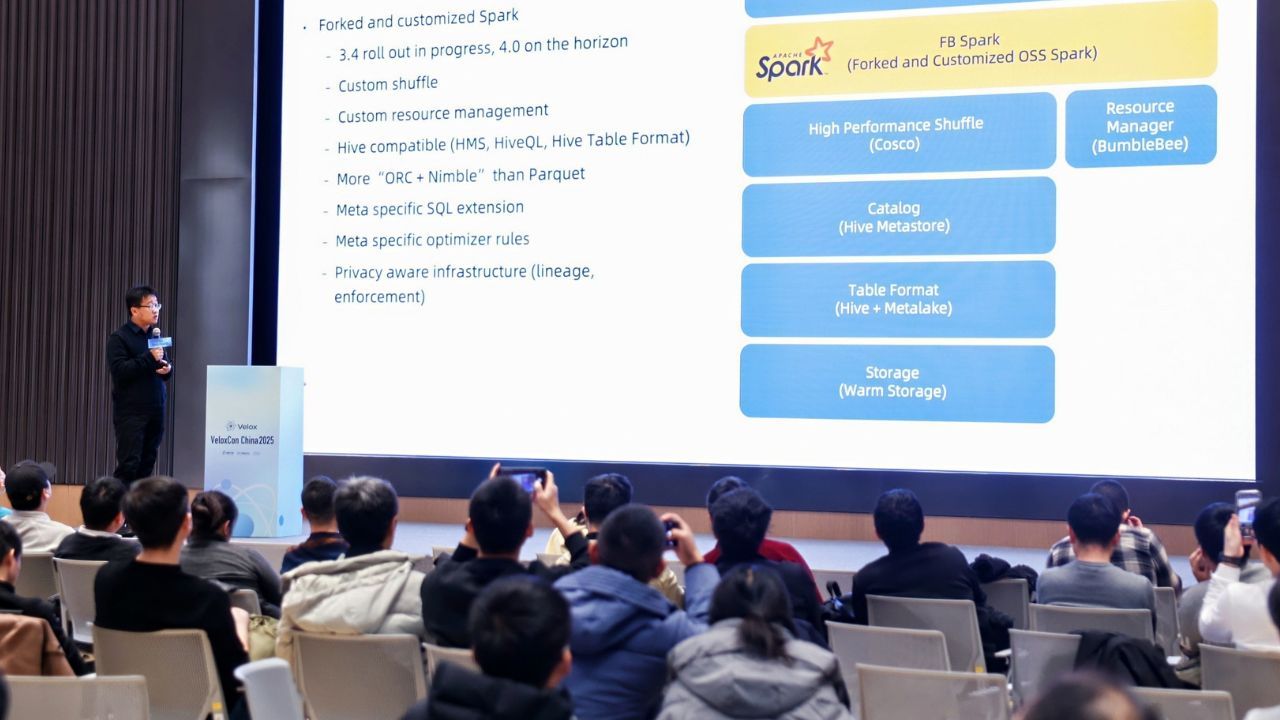
I recently returned from VeloxCon China 2025, where I had the chance to present and soak in the latest progress in the open source big data space. Listening through all the amazing presentations, I realized that the old way of building monolithic data silos is fading. The atmosphere was “electric”, reminding me of the early days of Kubernetes. If you want to land a dream job in data infra today, you need to understand that the ground is shifting beneath our feet.
As Marc Andreessen famously said, "Software is eating the world," but at VeloxCon, it was clear that AI is now eating the data engine. Here are the five trends I observed:
- The "AI-First" Pivot for Data Engines: A dominant theme across many companies is that data engines are no longer just for SQL. They are being rebuilt to serve the hungry “monsters” like Large Language Models (i.e., GenAI) and Recommendation Systems (i.e., traditional deep learning). This includes using Velox for training data normalization, feature injection, vector search, etc. By unifying the data stack, companies are eliminating the need for separate, inefficient Python or Java based preprocessing pipelines and enabling the processing of massive datasets (e.g., long user sequences) that were previously unsustainable.
- The Shift to "Composable" Native Vectorized Execution is Accelerating: The industry is moving aggressively away from monolithic JVM-based execution toward modular, composable C++ native engines like Velox. This trend is evident across major tech companies (e.g., Meta, Alibaba, Xiaomi, Xiaohongshu, and so on) using frameworks like Apache Gluten and Prestissimo to offload computation from Spark and Presto. The focus has shifted from experimental pilots to large-scale production deployments that yield significant cost reductions (up to 30-50%) and performance gains.
- Expansion from "Read-Only" to Native Lakehouse "Write" Support: While initial native acceleration focused on reading data, the industry is now deeply integrating native write capabilities for Lakehouse formats like Iceberg and Paimon. This includes supporting complex operations like rolling file updates, partition overwrites, and deletion vectors directly in C++ to avoid the performance penalty of passing data back to the JVM for writing.
- Integration of GPU Acceleration into Standard SQL Engines: There is a distinct trend toward heterogeneous compute, specifically integrating GPU acceleration (via NVIDIA cuDF) into the Velox ecosystem. This approach allows standard SQL engines (like Presto and Spark) to transparently offload compute-intensive stages (like Joins and Aggregates) to GPUs, utilizing high-bandwidth interconnects (like NVLink) to bypass CPU bottlenecks during data exchange.
- Emergence of Unification at the Frontends and across Stream/Batch: As adoption of native engines like Velox across many engines/systems, the fragmentation of the upper part of the stacks started to surface. To address the fragmentation and inefficiency of having separate optimizers (e.g., Catalyst in Spark or the Java coordinator in Presto) communicating with C++ backends, there is a push toward composable C++ frontends (Project Axiom). Simultaneously, architectures like Flex are utilizing Velox to unify streaming and batch processing within Flink, enabling shared native operators and memory management for both workloads.
Conclusion
The big data landscape is moving rapidly, leaning heavily into native execution and hardware acceleration. For big data professionals, the signal is clear: don't just learn a tool; learn the architecture. The "composability" trend means your skills need to be as modular as the engines we are building.
Subscribe to Newsletter
Get bi-weekly curated articles, tips, and resources for career success delivered to your inbox:


