
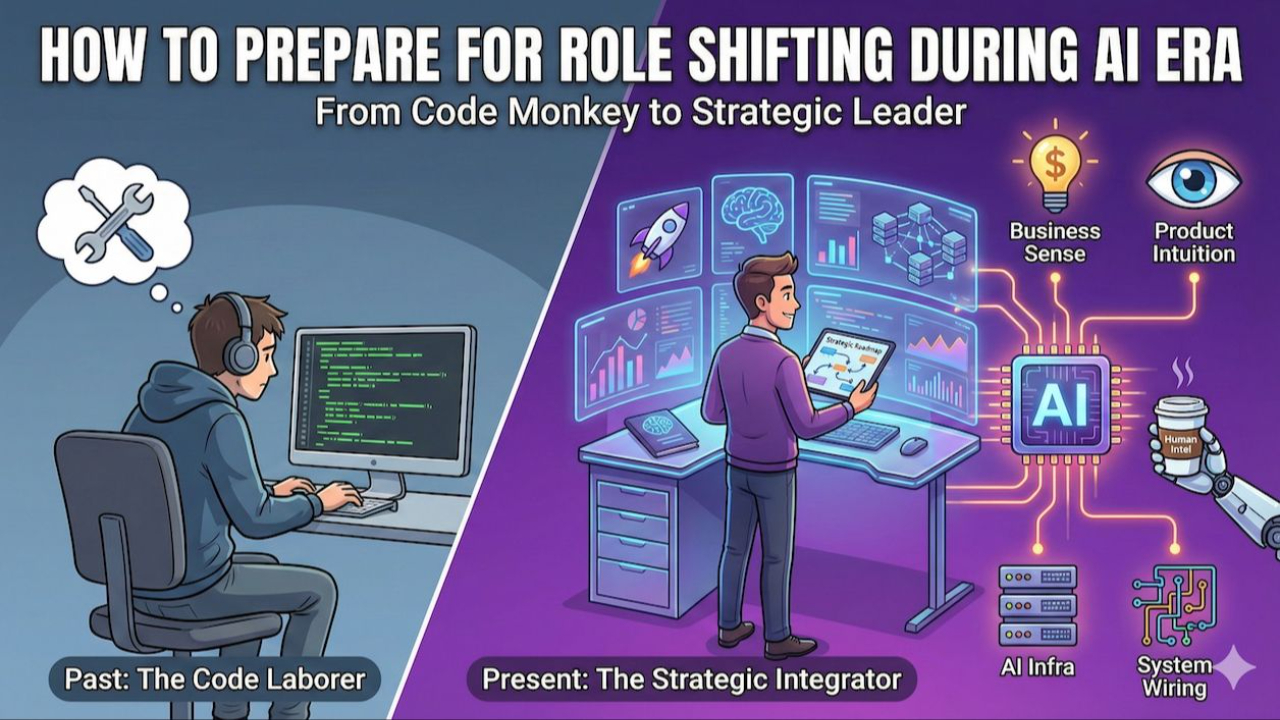
The "software engineer" role, as we knew it, is disappearing with a day by day countdown.
Remember the days when knowing the difference between a left join and a right join made you the smartest person in the room? Those days are fading faster than your last Zoom background. A recent study suggests that AI can now complete coding tasks up to 40% faster than a professional software engineer. For non-professionals (those who don't write code on the daily basis like me), the boost is at 10x or 100x level. I say this based on my direct hands-on experience with AI. If that does not make you sweat a little, you might already be a robot. :)
We are entering an era where the traditional boundaries of software engineering are dissolving. I have spent years leading engineering teams at FAANG companies, and I have seen the same pattern: the "expert coder" role is being replaced by something much broader. If you want to land your dream job today, you cannot just be an amazing coder. You need to be a strategist.
Why is this happening?
The reason for this tectonic shift is simple: the cost and entry barrier of software development is plummeting. As Steve Jobs once said, "The most important thing is the holistic view." In the past, the high entry barrier to building software meant you could survive just by being a productive coder hiding inside a cubicle wearing a gigantic ANC headphone shielding yourself from the outside world. Now, when a high schooler can vibe-code their way into a working MVP over a weekend, the value of pure syntax knowledge has hit rock bottom.
Where is the trend going?
As a result, high-tech roles are widening and consolidating in two directions. Downward, you are now expected to wire up and maintain the complex AI infrastructure that runs your code with the help of, well, AI itself. Upward, you must possess the business sense and product intuition to decide what should be built in the first place. You are no longer just an "implementer." You are becoming a mini-CTO and a mini-Product Manager combined into one. Because of the explosion of new products thanks to AI, you also need to be an amazing marketer for your work to stand out, regardless you are a startup founder or an employee of a big company.
This brings us to the most critical shift: the transition from labor-heavy skills to human-differentiating skills. Coding is becoming the "typing" of the 21st century. It is a prerequisite, not a differentiator. What matters now is critical thinking, judgment, taste, intuition, and collaboration. Can you tell when an AI generated solution is elegant or just a hallucinated mess? Do you have the intuition to pivot a feature when the data looks off? These are the skills that AI cannot replicate yet.
What should you do now?
To stay relevant, you must step out of your comfort zone. Stop hiding behind your IDE and start embracing the full stack of human intelligence. Take actions to make friends with AI agents (notice that I'm not calling them tools?). Expand your skills upward by learning the "why" behind your product or downward by mastering the infrastructure that powers the AI revolution.
As Jensen Huang recently noted, the "language" of computing is now human language. Are you speaking it well enough to lead, or are you just waiting for the next prompt?
How are you shifting your focus this year to stay ahead of the curve?
Subscribe to Newsletter
Get bi-weekly curated articles, tips, and resources for career success delivered to your inbox:


